Yes you read it correct!!! What you see below is a rare sight. An extremely well preserved ProStreet/Drag AMC Matador.
Sure I’ve seen AMX as a drag car and I’ve even seen a Gremblin and a Pacer with V8 shoved between the fenders, but I’ve never seen a Matador with a drag set up. And the condition is amazing.
See for yourself.
This is the Matador X
Also referred to as Matador Series 10
Control Freak Suspension specializes in AMC suspensions (and other makes).
The Matador X was a true sub-model not just a option package.
The Matador X had only a two year run 1974 and 1975.
As best as I can tell this is a 1975 and if the 401 badge on the side is correct, the is one of four cars (two door coupes) that left the factory with those engines that year (rest of the 84 cars with that engine were 4 door…hiss….boo!!!)
I would seriously consider doing up a Matador like this!!!
Got an interesting AMC? Drop me a note, we can get it published.
I realized that the name, Tempo Matador, could be formed from the model names of two other notable cars, the Ford Tempo and the AMC Matador. Realizing this, I screamed like a banshee and flipped over the table at the soft-serve frogurt shop I steal my …
I realized that the name, Tempo Matador, could be formed from the model names of two other notable cars, the Ford Tempo and the AMC Matador. Realizing this, I screamed like a banshee and flipped over the table at the soft-serve frogurt shop I steal my …
Today, however, we’re going back in time and to Detroit — actually, to Kenosha — for a long-out-of-production AMT kit that has us cranking up the Frijid Pink and catching a buzz off the Testors fumes: this AMC Matador Coupe. Yes, the seller hopes to …
If you haven’t seen it yet, here’s the video of the Jalopnik journalist hitting the wall with a 2016 mule Camaro. Enjoy and then check below for my commentary.
Clearly the guy felt bad and a little shaken up, but the reality is, he shouldn’t have driven the car. If you just look at the beginning frame of the video or notice the position of his arms just before he hit the wall, you can tell there the skill set just isn’t there.
I auto cross my cars – my C4 when I had it and my C6 now (not to mention my drag racing stint with my Mustang). I’ve attended my SCCA Solo courses and even attended some training with Bondurant at Phoenix International Raceway with Formula 1 cars. And what I’ve learned is that you must have more than just enthusiasm over a new car, especially a powerful one. You have to have some driving skills and you must have respect for the car’s abilities and know yours.
Here is a parallel event I was part of with my corvette club. We rented a part of the Bondurant facility to have an auto cross event. It included all generations of Corvettes as well as a few other non-Corvette vehicles. One of our members just purchased a brand new C6 and was very eager to run the course. Short version of the story is – he lost it on his second run, went through the chain-linked fence at a post and got the car hung up on the concrete footing. We had to dig him out and the Bondurant crew weren’t all that happy. Clearly he wasn’t ready for the abilities/power of his C6 even though he had the enthusiasm (and for pete’s sake keep the traction control on until you are used to the car).
Don’t get me wrong, accidents happen, just watch any F1, drag or NASCAR race and you’ll see professional skilled driver hit the wall. It happens.
Now back to the Jalopnik incident. If you watch the video you can tell the journalist seems pretty excited. However his driving skills seem a bit off in a number of ways. For instance, his sitting position is off, especially for track driving (maybe he’s just super tall or the mule car is not equipped with adjustable seats) for one. You can tell by his expression in a corner, prior to his last corner and the contact with the wall, that he was at he edge of his abilities with that particular car. As he goes into the now famous turn his arms cross – I didn’t realize a human could contort himself that much!!
I also found interesting was some of his commentary leading up to the crash with words like “rolly-poely”, “composed”, “nimble” especially in light of his comments that he was there to discuss the how it handles at the track. You must have the ability to test those things to give your readers a comparison and the proper (or more familiar) terminology helps e.g., replace “rolly-polly” with “body roll”. Wouldn’t GM want that too or at least his publisher?
There was a comment in his piece where he gave full disclosure, stating that GM wanted him to drive so badly, that they flew him out and paid for food and booze. Don’t know if that’s ‘special’ or standard fare. I also didn’t understand his comment – “GM asked me to leave the track” and they had to continued the video out in the street – seems a tough way to deal with someone, you really wanted there. Hopefully, GM doesn’t want their money back for the airfare or bill him for the damage to the mule.
Now I’m not a great blogger nor the greatest driver, but I do have car guy experience (including testing new models in a small auto cross scenario) and a fair grasp of the my native language. I’m not sure what all of his credentials are, he did say he had some track time, and I did look over some of his other entries and gained my own opinions.
It suffices to say that I much prefer a “car guy turned journalist” vs. “journalist turned car guy”, especially when to reading ‘car guy’ stuff and certainly for reviews like this one.
I do feel badly for him and GM and but I’m also sure it wasn’t the first time on media day that a writer dented one of the cars. He just had his published. And thank the auto gods that he wasn’t driving a Z28!!! I would have wept opening.
The 2016 Camaro SS is powered by a Corvette Stingray-sourced 6.2-liter V8 that produces 455 horsepower and 455 pound-feet of torque. By comparison, the 2015 Camaro SS has 426 horsepower and 420 pound-feet of torque. No matter the engine, the …
There are some areas of your drag, oval or road course beast that are weak areas for the stress of 420 hp and 400 ft-lbs of torque. Here is a great way to eliminate one. Chase the link at the bottom for the complete story from Chevy Hardcore!!
When considering the essential parts list for a race car build, we tend to think of exhaust headers, cylinder heads, turbochargers and so on. While it might not be the most glamorous piece of the puzzle, the starter is an absolutely vital component in your build – if it kicks the bucket, you’re dead in the water. And though it may not see the same sort of prolonged stresses that a driveshaft or set of tires sees on race day, it’s still contending with plenty of abuse from heat exposure and demands of high performance components which typically operate far outside the design specifications of an OEM starter.
But it was Dreyer’s government which plumped for an unlikely Nürburgring buyer: auto racing parts company Capricorn with a head office not far north of the circuit in Düsseldorf. Her transport minister, Roger Lewentz, said at the time that it was …
Roo Motorsports, the new Aussie NASCAR team based in Salisbury, plans to enter the truck-racing series next year and perhaps the Nationwide series in the future. Roo held an event, complete with satellite link to owners in Australia, earlier this month …
I’m a bit old school about driving like feeling the road (yeah even the pot holes!!) and not floating, making a car hit the curve just right and shoving the clutch pedal to the floor and find the next gear! That’s all part of the enjoyment for me. But paddle shifting is here to stay and I’ll be disappointed if the clutch pedal disappears from all new cars.
I’m sharing this article from Mind Over Motor as it hits on some key points I can relate too when it comes to this “new fangled” 🙂 way of changing gears.
Mind Over Motor
I am someone who has publicly lamented the decline of the manual transmission. But I’m also someone who has enjoyed the merits of modern paddle shift gearboxes in many cars.
I find myself very much split on this issue, so lets take a look at the various reasons why shifter paddles are replacing a gear lever and a third pedal in some of our favorite cars.
Note: To clear this up right away, by “paddle shift” I mean cars with automated manual gearboxes, either dual-clutch or single-clutch. I am in no way talking about anything like a Toyota Camry with the “sport package”, which has paddle shifters as a marketing gimmick.
1. More versatile on the road. (Having your cake and eating it too)
If you had something like a Lamborghini Diablo back in the mid 1990s chances are you had a lot of fun out on the open road. However, when you got into town and hit traffic, the heavy clutch made driving the car more of a $250,000 chore than an enjoyable way to spend a weekend afternoon. Considering the average speed of traffic on most roads is around 25-30mph, you’d be spending far more time putting along slowly than stretching the car’s legs. It’s a wonder why most owners hardly ever drove their exotic cars.
Today, Lamborghini only offers their cars with a paddle shift transmission. The sales numbers spoke for themselves, once paddle shift was offered back around 2004, demand for manual Lambos simply fell off.
Paddle shift basically solved all the issues described above with the Diablo. Now, in an Aventador, you can rip your way into town and then just put the car in automatic mode when you hit traffic. You have a car that is a ferocious supercar when you want one, but is also just as easy to drive as a Toyota Camry when you don’t. You are no longer writing a six-figure check to put yourself through misery. And I agree, that is a major plus, especially in cars that had very difficult manual gearboxes like most supercars did.
Chase the link below for the rest of the article and come back and let me know what YOU think!!
Paddle Shifting the 997. Porsche 997 GT3 Cup Paddle Shifter. Created by Holinger, supplier of gearbox components to Porsche AG, this paddle shift system is designed specifically for the 997 GT3 Cup, replaces the tunnel-mounted sequential …
Paddle shifters are the ultimate “cool factor” of a car. For people who experience paddle shifting for the first time, you might as well be Mario Andretti. They look super cool on the car, and are functionally genius. However, there …
The automatic features several shift modes, as well as manual paddle-shifting, and the manual transmission features automatic rev-matching for drivers who haven’t yet mastered the heel-toe shift method, and it has a no-lift shift feature allowing you …
Nestled in the engine compartment is Audi’s familiar, silky-smooth direct-injected 2.0L TFSI turbocharged four-cylinder engine, mated to a traditional six-speed automatic transmission with Tiptronic paddle shifting. The engine churns out 200 horsepower …
While we all realize that cars are depreciating assets and therefore lose value with time and usage, many enthusiasts try to do everything possible to slow down this process. Some enthusiasts will go to the extent of covering their car daily, intentionally reduce the usage of their car, or even park their car when its brand new only to never use it for collector value.On the flip side of this, there are a lot of enthusiasts that believe “a car is meant to be driven” and will use their Corvette as if it were a Honda Civic in daily driving conditions. Both groups are very passionate about their opinions and if you ask either party, they will tell you that they are right and the other group is wrong.Whether you preserve your cars or drive your cars, one aspect of vehicle ownership that is sure to rapidly decrease the value of your car is an accident. Unfortunately for the driver of this video, they found out the hard way that while a beautiful black on black C5 may have a strong resale market when it looks great, that is not the case after a severe accident. Judging by the video, this black on black C5 ran right off the road– and into the trees. The impact of hitting the trees was severe enough to thoroughly mangle the front end of the car and deploy both front airbags. Often times, once the airbags deploy, the car gets totaled, which is unfortunate. Without having a video of the actual incident, one can speculate that speed was involved and the car was potentially pushed too far. Sad to see but hopefully they had some great insurance!
My Note: I’m the guy that drives his corvette like a Honda…only faster!!! Yes they sure did a job on this one but I don’t think they over drove the cars capabilities, more like the driver exceeded his abilities, which is usually the case with hi-performance cars.
Every now and then it’s not about cars, racing or banging on car fenders. But it’s always about Words.
Although this is a bit about cars, because this popped into my head when I was reading the book “A Most Unique Machine” by George S. May. Any excellent read if you like the history part of this passion of ours – cars.
In the book they grab excerpts of real period accounts and news articles about the dawn of the auto industry in the United States – which was mid morning to the rest of the world – as we were behind many European countries.
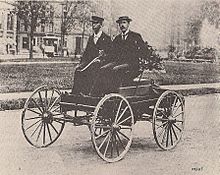
These excerpts came from a time when words stood lone. Words like ‘marvelous’, ‘wonderful’ and ‘unique’. The use of these words meant some thing back then. They were reserved words, used to emphasize important events or objects. The word ‘unique’ really meant something special. Here’s an example from the Detroit Journal: ‘when in motion, the connecting rods fly like lightning, and the machine is capable of running seven or eight miles an hours…a most unique machine.’
This excerpts is a description of Charles King’s evening joy ride in his gas powered horseless carriage in March of 1896. Of his version of the car he said…”I am convinced they (horseless carriages) will in time supersede the horse.”
Back then words such as ‘fly like lightning’ or even words like ‘capable’ and ‘unique’ were as good as it got. If someone called you ‘capable’ that was high praise as was ‘unique’ and if you supersede someone or something it meant you were the best. In today “drama – filled, I need attention writing these are lame words.
Can you image describing the winning top-fueled drag car – fast as lightning? Certainly not (hell no) it would be friggin’ fast.
Words meaning have been muted by adjectives and adverbs.
Ok on to my next audacious, awesome filled, friggin’ outstanding article.
Here we have Ruff Bolt and the King’s Horseless Carriage. Ruff Bolt is a funny automatic controlled plane which can fly 10,000 km per second! The Kings Horseless Carriage is small, cozy, and pretty fast. Both Ruff Bolt and …
King’s “horseless carriage” moved down Woodward Avenue to the surprise of pedestrians. The next day a local newspaper called it “a most unique machine.” King became the first Detroiter—and possibly the first …
I’ve never been a “caddy” guy. Well that’s not true. I’d would drive a 60’s or less Caddy. But I haven’t seen anything I’d take over a Corvette since then.
Sometimes we forget how things evolved when it comes to the functioning of our cars. Sometimes to understand how they work its helpful to go back in time and view how the problem was solved.
Take for instance this 1937 GM film on how to solve cornering.